


Planning for the future is one of the most important steps you can take for your loved ones. At Frame & Frame Attorneys at Law, we understand that life changes often require updates to your estate planning documents, particularly your will. But what happens when you only need to make a minor change without starting from scratch? That is where a codicil comes into play.
This guide breaks down everything Maryland residents need to know about codicils to wills, including their purpose, legal requirements, potential risks, and when a codicil is the right choice versus drafting an entirely new will. If you are considering updating your will, contact Frame & Frame Attorneys at Law today at 410-255-0373 to help you determine the best approach for your situation.
What Is a Codicil to a Will?
A codicil is a legal document that allows you to make changes or amendments to an existing will without revoking the entire document. Think of it as a formal addendum that modifies specific provisions while keeping the remainder of your original will intact.
Codicils have been used in estate planning for centuries, and they remain a practical tool for addressing straightforward updates. When properly executed, a codicil carries the same legal weight as the will it modifies.
Common Uses for a Codicil
Codicils are most appropriate for minor, targeted changes to your will. Some of the most common reasons Maryland residents use codicils include:
- Changing the executor or personal representative of the will
- Updating beneficiary designations after a birth, death, or change in relationship
- Adding or removing specific bequests, such as giving a particular asset to a different person
- Correcting errors in the original will, including misspellings, incorrect addresses, or outdated information
- Adjusting the guardian designation for minor children
- Modifying charitable bequests or donations
Because a codicil is legally binding, it must adhere to the same formalities required for creating a valid will under Maryland law, including proper signing and witnessing.
How a Codicil Works in Maryland
In Maryland, creating a valid codicil follows essentially the same process as creating a valid will. The state has specific requirements that must be met for a codicil to be enforceable.
Legal Requirements for a Valid Codicil
Maryland law requires the following for a codicil to be legally binding:
- Written Document. A codicil must be in writing and clearly describe how it modifies the original will. Oral modifications to a will are not valid in Maryland.
- Signed by the Testator. The person creating the codicil (the testator) must sign the document. The signature confirms that the testator approves of the changes and is acting voluntarily.
- Two Witnesses. Maryland requires that at least two witnesses be present when the codicil is signed. These witnesses must also sign the document to confirm its validity. Witnesses should be individuals who are not beneficiaries under the will or codicil, as this can create conflicts of interest and potential grounds for a legal challenge.
- Mental Capacity. The testator must be of sound mind when executing the codicil. This means they must understand the nature and extent of their property, know who their beneficiaries are, and comprehend the effect of the changes they are making.
Failing to meet any of these requirements can lead to the codicil being declared invalid by a probate court, which could create confusion and conflict among your beneficiaries.
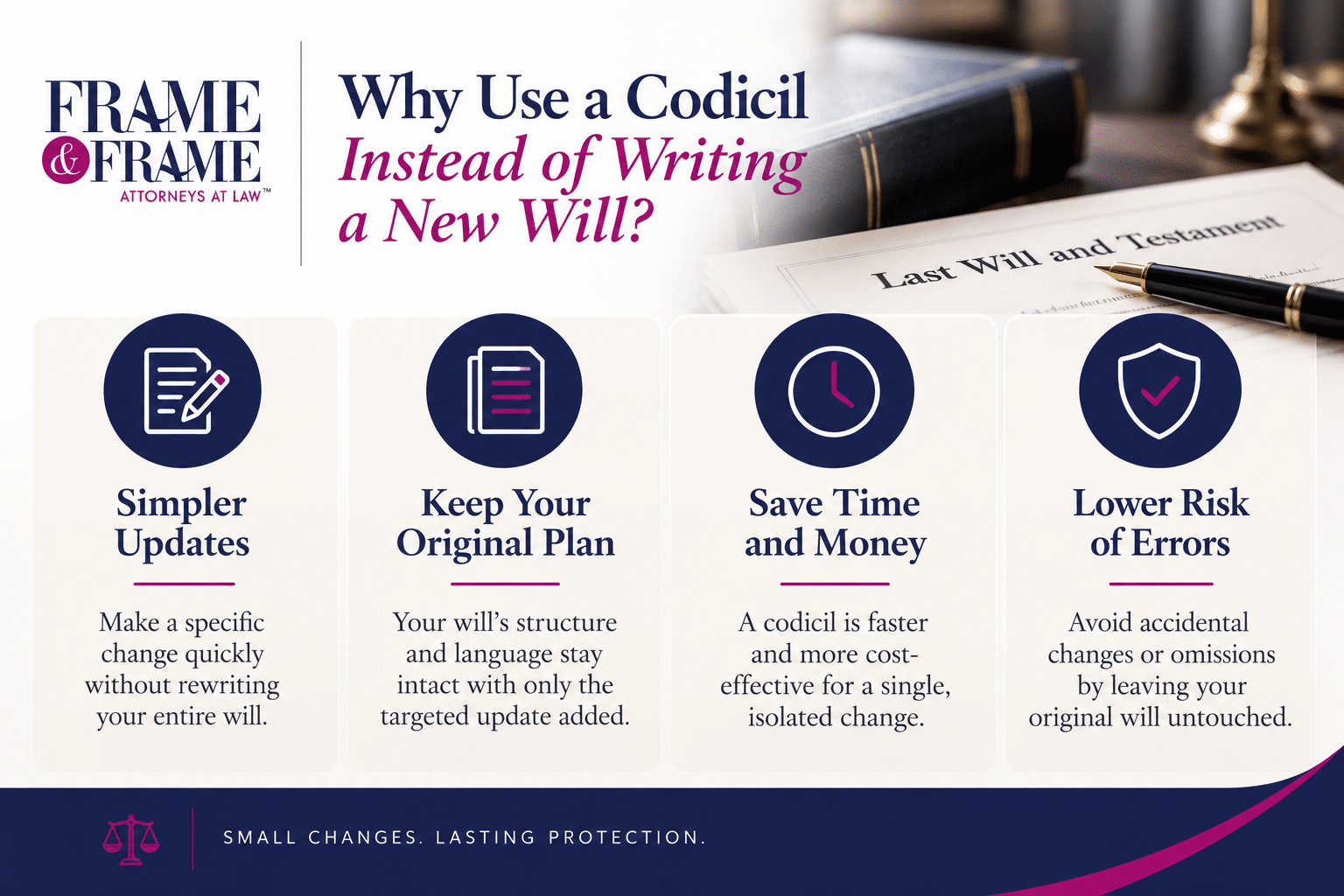
Why Use a Codicil Instead of Writing a New Will?
It might seem easier to simply rewrite your will whenever you want to make a change, but that is not always the most practical approach. Codicils offer several advantages in the right circumstances.
Simplifying the Update Process
When you only need to add or remove a single element, such as changing a beneficiary or updating an executor, a codicil can accomplish the task much faster than completely rewriting your will. This is especially helpful when the rest of your estate plan remains unchanged.
Preserving Continuity
With a codicil, the original structure and language of your will remains intact. This makes it easier to reference both documents together when settling your estate. Everything that was carefully considered and drafted in the original will stays in place, with only the targeted modification added.
Saving Time and Resources
Drafting a brand-new will involves reviewing every provision, beneficiary, and asset distribution from scratch. For a single, isolated change, preparing a codicil is typically faster and more cost-effective.
Reducing the Risk of Errors
When a new will is drafted, there is always a risk that something from the original will is inadvertently omitted or changed. A codicil avoids this risk by leaving the original document untouched and simply layering the amendment on top.
When Should You Draft a New Will Instead?
While codicils are useful for minor changes, there are situations where drafting an entirely new will is the better approach. Understanding the difference is key to maintaining a clear and enforceable estate plan.
Multiple Changes Needed
If you need to make several changes at once, such as updating multiple beneficiaries, changing the distribution of assets, and adding new provisions, a new will is almost always the better option. Stacking multiple codicils on top of one another creates confusion and increases the risk of contradictions.
Major Life Events
Significant life changes often warrant a complete review and rewrite of your will. These include:
- Marriage or divorce
- The birth or adoption of a child
- The death of a spouse, beneficiary, or executor
- A substantial increase or decrease in your assets
- Moving to a different state (since estate laws vary by jurisdiction)
- Changes to your trust arrangements
Previous Codicils Already Exist
If your will already has one or more codicils attached to it, adding yet another amendment can make the document difficult to interpret. In this situation, it is far better to consolidate everything into a single, updated will that clearly reflects your current wishes.
Complex Asset Changes
If your estate has grown significantly or you have acquired complex assets such as business interests, real estate in multiple states, or investment portfolios, the distribution provisions in your original will may no longer be adequate. A new will allows you to address these complexities comprehensively.
The Relationship Between Codicils and Other Estate Planning Documents
A codicil modifies your will, but your will is only one component of a comprehensive estate plan. Understanding how a codicil interacts with your other documents is important for keeping everything consistent.
Powers of Attorney
Your will and your powers of attorney serve different purposes. Your will governs what happens to your assets after your death, while a power of attorney allows someone to act on your behalf during your lifetime. If you are updating your will via a codicil, it is a good time to review whether your financial and healthcare powers of attorney also need updating.
Trusts
If you have established a revocable or irrevocable trust, the relationship between your will and your trust is critical. Many people have a “pour-over” will that directs any assets not already in the trust to be transferred into it upon their death. If you modify your will via a codicil, make sure the changes do not conflict with the terms of your trust. Inconsistencies between your will and trust can lead to costly probate disputes.
Beneficiary Designations
Certain assets, such as retirement accounts, life insurance policies, and payable-on-death bank accounts, pass to beneficiaries outside of your will based on beneficiary designation forms. A codicil to your will cannot override these designations. If you want to change the beneficiary of a retirement account or insurance policy, you must update the designation directly with the financial institution or insurance company.
Potential Risks and Pitfalls of Using a Codicil
While codicils can be convenient for minor updates, there are potential risks you should be aware of before choosing this approach.
Confusion or Misinterpretation
If the language in the codicil is not precise, or if the changes conflict with other parts of the will, disputes may arise among beneficiaries. This is one of the most common problems with codicils and is a strong argument for having an experienced attorney draft the document.
Multiple Codicils Over Time
Adding several codicils over the years can make your estate plan harder to interpret, increasing the likelihood of disagreement among beneficiaries. When a personal representative needs to read the original will plus three or four codicils to understand your wishes, errors and misunderstandings become more likely.
Outdated Provisions
Laws change, and so does your life. Relying solely on codicils without periodically reviewing your entire estate plan can lead to unintended consequences. For example, Maryland’s estate tax thresholds and exemptions have changed over the years, and your plan should reflect current law.
Formalities Not Properly Followed
A seemingly minor oversight, like forgetting to have proper witnesses or failing to have the testator sign on every page, could result in the codicil being declared invalid. This is why working with a qualified attorney is strongly recommended.
Physical Separation from the Will
A codicil is a separate physical document from your will. If the codicil is lost, misplaced, or stored in a different location from your will, it may never be discovered or presented to the probate court. Always store your codicil together with your original will in a safe, accessible location.
How to Create a Codicil in Maryland: Step by Step
If you have determined that a codicil is the right approach for your situation, here is a general overview of the process.
- Step 1: Identify the specific changes you want to make. Before meeting with your attorney, write down exactly what you want to change in your will. Be as specific as possible about which provisions you want to modify, add, or remove.
- Step 2: Consult with an estate planning attorney. An experienced estate planning attorney can review your existing will and advise whether a codicil or a new will is the better approach. They will also ensure that the changes do not create conflicts with other provisions in your will or with your overall estate plan.
- Step 3: Draft the codicil. Your attorney will prepare the codicil, clearly referencing the original will and specifying the exact changes being made. The language must be precise and unambiguous.
- Step 4: Execute the codicil with proper formalities. You must sign the codicil in the presence of two witnesses, who must also sign the document. The signing should follow the same formalities as the execution of a will.
- Step 5: Store the codicil with your original will. Keep the codicil attached to or stored with your original will. Inform your executor, personal representative, or attorney of its existence and location.
Frequently Asked Questions About Codicils
Are codicils as legally binding as a will?
Yes. Once properly executed, a codicil has the same legal standing as your original will. It serves as an official amendment, allowing you to make specific changes without rewriting the entire document. Codicils are useful for updates like adding beneficiaries, adjusting inheritance amounts, or changing executors while maintaining the validity of your original will.
Do I need a lawyer to create a codicil?
Maryland does not require a lawyer for estate planning, but working with an experienced attorney offers significant benefits. An attorney can ensure your documents are error-free, properly executed, and compliant with state laws. They can also identify potential issues that a layperson might miss, such as conflicts between the codicil and other estate planning documents.
Can a codicil be contested?
Like wills, codicils can be challenged in court if there are concerns about fraud, coercion, undue influence, or lack of mental capacity. For instance, if someone suspects the testator was pressured or unaware of their actions due to illness or cognitive decline, these could be valid grounds for dispute. A codicil must be created voluntarily and with a clear understanding of its implications to be considered valid.
Should I draft a new will if I already have several codicils?
Yes. If your will has multiple codicils, it can become confusing and harder to interpret, leading to potential disputes. Over time, multiple amendments may complicate the document, making it difficult for heirs and executors to understand your intentions. Creating a new, updated will ensures clarity and provides a straightforward guide for your loved ones.
Can I write a codicil myself?
Although creating a DIY codicil is technically possible, it comes with significant risks. Imprecise language or failure to adhere to Maryland’s legal requirements could render the codicil invalid. By working with a trusted law firm, you can ensure your codicil is properly drafted, legally sound, and fully enforceable.
What happens if my codicil contradicts my will?
If a provision in the codicil directly contradicts a provision in the original will, the codicil generally takes precedence for that specific provision. However, ambiguous or contradictory language can lead to litigation. This is one of the strongest reasons to work with an attorney who can ensure clarity and consistency across all your estate planning documents.
How much does it cost to create a codicil in Maryland?
The cost of creating a codicil varies depending on the complexity of the changes and the attorney’s fees. Generally, a codicil is less expensive than drafting an entirely new will because fewer provisions need to be reviewed and drafted. Your attorney can provide a specific estimate based on your situation.
Work with an Experienced Maryland Estate Planning Attorney
Estate planning can feel overwhelming, but it does not have to be. At Frame & Frame Attorneys at Law, we specialize in wills, trusts, and estate planning tailored to meet the needs of Maryland families. With over 70 years of combined experience, our team understands the nuances of Maryland estate law and is committed to helping you protect your family’s future.
Whether you need a minor update through a codicil or a comprehensive revision of your entire estate plan, our dedicated attorneys are here to guide you through every step of the process.
Take the First Step in Securing Your Peace of Mind
Your will is one of the most important documents you will ever create. Whether you need a minor update or a significant revision, having a trusted attorney ensures your wishes remain clear and legally sound.
If you have questions about codicils, wills, or any aspect of estate planning in Maryland, contact us today at 410-255-0373 to schedule a consultation. Whether your changes are big or small, the peace of mind you will gain is priceless.