


If you are preparing to send your child off to college, you may have a flurry of preparations underway. From dorm room essentials to class schedules, the checklist can seem endless. However, there is one crucial item that parents often overlook amidst the excitement: once your child turns 18, you no longer have the legal authority to make decisions on their behalf. Without the proper documents in place, you may not be able to access their medical records, speak with their doctors, manage their finances, or handle legal matters during an emergency.
Having a power of attorney for your college-age children is not just a formality. It is a vital safeguard that ensures you can step in when your child needs you most. In this guide, we will explain the types of powers of attorney every parent of a college student should consider, what Maryland law requires, and how to get these documents in place before move-in day.
What Changes When Your Child Turns 18
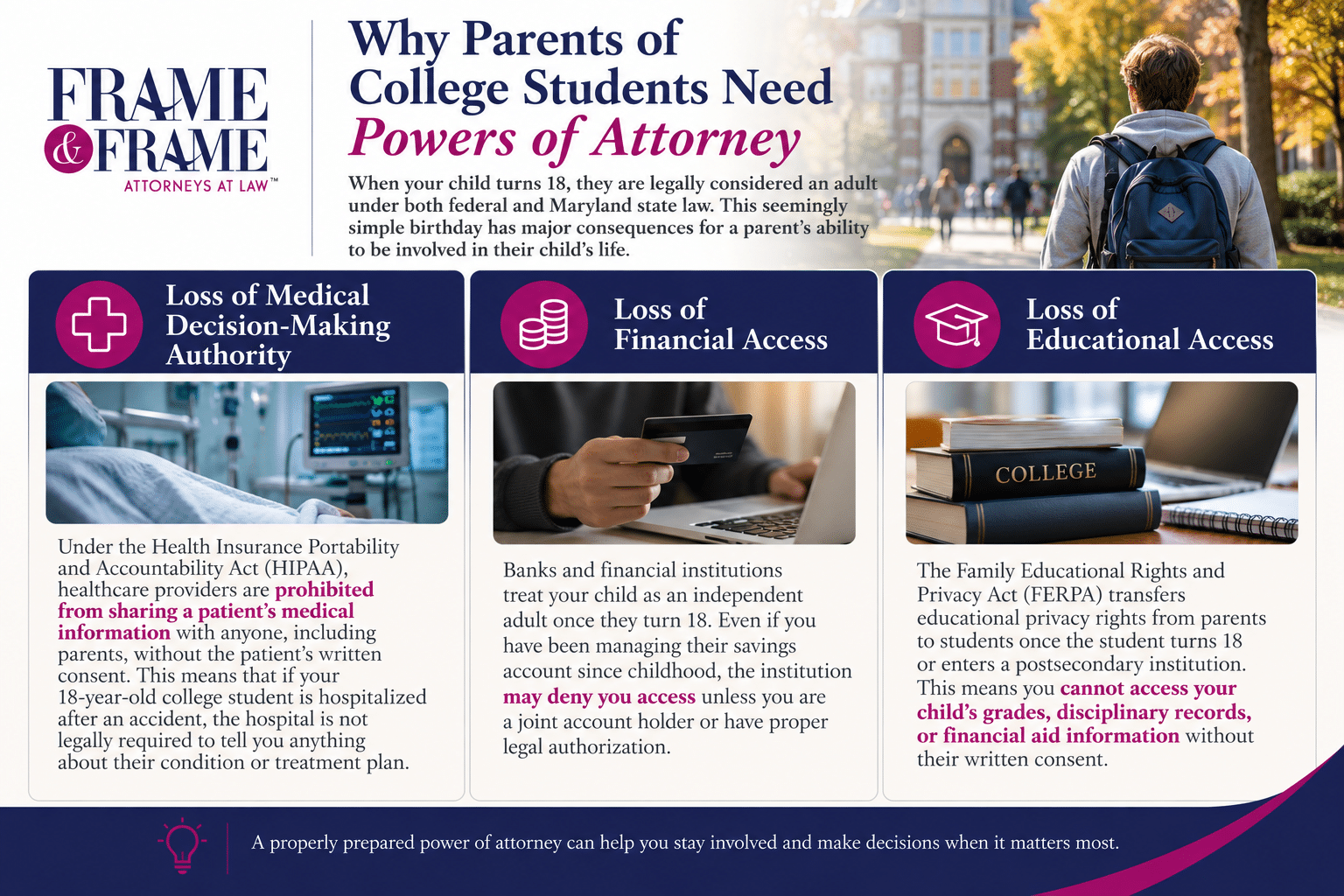
Many parents are surprised to learn that the moment their child turns 18, they are legally considered an adult under both federal and Maryland state law. This seemingly simple birthday has sweeping consequences for a parent’s ability to be involved in their child’s life.
Loss of Medical Decision-Making Authority
Under the Health Insurance Portability and Accountability Act (HIPAA), healthcare providers are prohibited from sharing a patient’s medical information with anyone, including parents, without the patient’s written consent. This means that if your 18-year-old college student is hospitalized after an accident, the hospital is not legally required to tell you anything about their condition or treatment plan.
Loss of Financial Access
Banks and financial institutions treat your child as an independent adult once they turn 18. Even if you have been managing their savings account since childhood, the institution may deny you access unless you are a joint account holder or have proper legal authorization.
Loss of Educational Access
The Family Educational Rights and Privacy Act (FERPA) transfers educational privacy rights from parents to students once the student turns 18 or enters a postsecondary institution. This means you cannot access your child’s grades, disciplinary records, or financial aid information without their written consent.
Understanding the Types of Power of Attorney
A power of attorney is a legal document that grants one person (the agent) the authority to act on behalf of another person (the principal) in specific matters. For college students, two types of power of attorney are most important.
Healthcare Power of Attorney
A healthcare power of attorney, also known as an advance directive or medical power of attorney, authorizes a designated agent to make medical decisions on behalf of the principal if they become incapacitated or unable to communicate. This document is essential for college students because it allows parents to:
- Access medical records and communicate with doctors
- Consent to or refuse medical treatments
- Make decisions about surgeries, medications, and care plans
- Authorize transfer to a different medical facility
In Maryland, the healthcare power of attorney is governed by the Maryland Health Care Decisions Act. The document must be signed by the principal (your child) while they are of sound mind and witnessed by two individuals. It goes into effect only when the principal is unable to make their own decisions.
Financial Power of Attorney
A financial power of attorney grants the agent authority to manage the principal’s financial affairs. For a college student, this might include:
- Paying bills, including tuition, rent, and utilities
- Managing bank accounts and investments
- Filing tax returns
- Handling financial aid paperwork and student loan matters
- Signing a lease for off-campus housing
Maryland law allows for both general and limited financial powers of attorney. A general power of attorney grants broad authority over all financial matters, while a limited power of attorney restricts the agent’s authority to specific tasks or time periods. Many families opt for a limited power of attorney that covers common college-related financial needs.
Why a HIPAA Authorization Is Also Essential
In addition to a healthcare power of attorney, parents should also have their college student sign a HIPAA authorization form. While the healthcare power of attorney kicks in only when the student is incapacitated, a HIPAA authorization allows parents to access medical information and communicate with healthcare providers even when the student is conscious and able to make their own decisions.
This is particularly important for situations that are not emergencies but still require parental involvement, such as:
- Helping your child navigate a new diagnosis
- Coordinating with specialists or therapists
- Managing insurance claims and medical billing
- Staying informed about ongoing treatments or prescriptions
Without a HIPAA authorization, a doctor cannot even confirm to you that your child is a patient at their facility. Having this document in place ensures open communication between you, your child, and their healthcare team.
Medical Emergencies and Why Every Second Counts
College is a time of newfound independence, where students begin making important decisions on their own. However, when it comes to medical emergencies, having a power of attorney in place is invaluable. Medical institutions are often stringent about sharing information or making decisions without proper authorization.
Imagine a scenario where your college student is involved in a serious car accident near campus. They are unconscious and unable to communicate. Without a healthcare power of attorney, the hospital’s medical team will make all treatment decisions without any input from you. You may not even be able to learn what happened or how your child is being treated.
By designating a parent as the agent under a healthcare power of attorney, the hospital can immediately involve you in treatment decisions. You can consent to emergency surgery, approve medications, and coordinate with specialists. In critical situations, the ability to act quickly can make a real difference in outcomes.
Financial Matters and the College Experience
Financial independence is another hallmark of the college experience. Yet this newfound autonomy can also present challenges, as many students lack the financial literacy and experience needed to manage money effectively. A financial power of attorney gives parents the ability to step in and assist when needed.
Tuition and Financial Aid
If your child is studying at a Maryland university or out of state, financial aid matters can be time-sensitive. A missed deadline for a scholarship application or financial aid renewal could cost thousands of dollars. With a financial power of attorney, you can handle these tasks on your child’s behalf if they are unavailable or overwhelmed.
Lease Agreements and Housing
Many students move into off-campus housing during their college years. Signing a lease is a legally binding commitment, and having a power of attorney allows parents to review and sign lease agreements, negotiate terms, or handle disputes with landlords if necessary.
Tax Filing and Banking
College students often earn income through part-time jobs, internships, or freelance work. Managing tax obligations while balancing coursework can be difficult. A financial power of attorney allows parents to file tax returns, manage bank accounts, and address any financial issues that arise.
Legal and Administrative Tasks
Navigating the legal and administrative landscape can be overwhelming for anyone, let alone a college student focused on coursework and campus life. A power of attorney can provide parents with the authority to sign legal documents on behalf of their child, handle administrative tasks, and even represent them in legal proceedings if necessary.
For example, if a student needs to respond to a legal notice, deal with an insurance claim after a car accident, or handle a dispute with a university, a parent with the proper legal authority can step in and advocate for their child’s best interests without delays caused by establishing authority at the last minute.
Mental Health Considerations
Mental health is a critical aspect of a college student’s well-being. The pressures of academia, social interactions, and newfound responsibilities can take a toll on mental health. According to recent studies, anxiety and depression rates among college students have increased significantly over the past decade.
In situations where a student requires mental health support or therapy, having a healthcare power of attorney and HIPAA authorization in place facilitates communication between parents and mental health professionals. This communication can contribute to better-informed decisions about the student’s care and overall well-being.
If your student experiences a mental health crisis, you want to be able to communicate with treatment providers, understand the care plan, and support your child’s recovery. Without the proper documents, you may be left in the dark during the most important moments.
What Maryland Law Requires
Maryland has specific requirements for powers of attorney to be legally valid. Understanding these requirements ensures your documents will hold up when you need them.
Healthcare Power of Attorney Requirements
Under the Maryland Health Care Decisions Act, a valid healthcare power of attorney must be:
- In writing
- Signed by the principal (your child)
- Witnessed by two individuals who are not the appointed agent
The document takes effect only when the principal is determined to be unable to make their own healthcare decisions, typically by a physician’s assessment. Maryland also allows individuals to include specific instructions about their treatment preferences within the document.
Financial Power of Attorney Requirements
Maryland’s financial power of attorney requirements include:
- The document must be in writing and signed by the principal
- The principal must be of sound mind at the time of signing
- Notarization is strongly recommended, as many financial institutions require it
A durable financial power of attorney remains in effect even if the principal becomes incapacitated, while a non-durable power of attorney terminates upon incapacitation. For college students, a durable power of attorney is generally recommended to cover all potential scenarios.
When to Get These Documents in Place
The best time to prepare powers of attorney and HIPAA authorizations for your college student is before they leave for school. Ideally, these documents should be executed during the summer before their freshman year, when your child is available to sign the paperwork and discuss their preferences.
However, it is never too late to get these documents in place. If your child is already in college and you have not addressed this, make it a priority during their next visit home or school break. An experienced estate planning attorney can prepare all the necessary documents efficiently.
Frequently Asked Questions About Powers of Attorney for College Students
Does my child need a full estate plan at 18?
While a comprehensive estate plan is valuable at any age, the minimum documents every 18-year-old should have are a healthcare power of attorney, a financial power of attorney, and a HIPAA authorization. These three documents cover the most common situations where parents need legal authority to act on behalf of their adult child.
Can my child revoke the power of attorney?
Yes. Your child can revoke a power of attorney at any time, as long as they are mentally competent. Revocation should be done in writing, and all relevant parties (including healthcare providers, financial institutions, and the named agent) should be notified.
What if my child goes to school out of state?
Powers of attorney executed in Maryland are generally recognized in other states, though some states have specific forms or requirements. If your child attends college out of state, it may be wise to prepare documents that comply with both Maryland law and the laws of the state where they attend school. Your attorney can advise on the best approach.
Does a power of attorney expire?
In Maryland, a durable power of attorney does not expire unless it includes a specific termination date or the principal revokes it. However, some financial institutions may question documents that are more than a few years old. Updating the documents periodically, such as every four years during college, is a good practice.
Can I add my child to my own estate plan instead?
Adding your child as a beneficiary in your own estate plan is a separate matter from obtaining a power of attorney for them. Your estate plan addresses what happens to your assets after your passing. A power of attorney for your college student addresses their needs during their lifetime. Both are important, and they serve different purposes.
What if my child is in a medical emergency and I do not have a power of attorney?
Without a healthcare power of attorney, you would need to petition the court for guardianship to gain legal authority over your child’s medical decisions. This process is time-consuming, expensive, and stressful, especially during a medical crisis. Having documents in place in advance avoids this entirely.
Protect Your College Student Before They Leave Home
Sending a child off to college marks a significant milestone for both parents and students. While it is a time of growth and independence, it is important not to overlook the practical legal steps that can make the journey smoother and more secure. A power of attorney might seem like a formality, but it is a powerful tool that provides parents with the ability to offer support when it matters most.
At Frame & Frame Attorneys at Law, we have helped thousands of Maryland families prepare the legal documents they need to protect their children during the college years and beyond. Our team of experienced elder law and estate planning attorneys makes the process straightforward and affordable.
Contact us today to schedule a consultation and ensure your family is prepared before your student heads to campus.