
Fall and the approaching holiday season is when Maryland families start coming back together—weekends home, holidays on the calendar, and that familiar thought: we should probably look at the paperwork. Most people don’t need a brand-new estate plan. They need the plan they already have to catch up with the year they just lived. Our estate planning checklist will get you started!
At Frame & Frame, we have served Maryland families for more than 70 years—often parents, then children, then grandchildren. We know how quickly life moves and how easily documents fall behind. A refinance, a new grandchild, a parent who needs more help, a retirement account opened at work: any one of those can leave a gap. This checklist is designed to close those gaps before the holidays swallow the calendar.
You don’t have to fix everything in one sitting. But, you do have to stop assuming last year’s plan still fits this year’s life. The checklist below will help.
1. Check who inherits—on every account, not just the will
A will only controls assets that pass through probate. Retirement accounts, life insurance, and many bank or brokerage accounts pass by beneficiary designation. That form wins, even if your will says something different.
Look at:
- 401(k), IRA, and other retirement accounts
- Life insurance and annuities
- Payable-on-death or transfer-on-death accounts
Ask one question: If I died this week, who actually receives this? An old form can send money to an ex-spouse, a deceased relative, or one child when you meant to treat all of them equally. Updating beneficiaries is often the fastest, highest-impact change you can make this fall.
2. Confirm the people you named can still do the job
An estate plan is only as strong as the people in it. Review:
- Executor / personal representative
- Trustee and successor trustee
- Financial power of attorney
- Health care agent
- Guardian for a minor child
Are they still the right choice? Do they know they were named? Can they still serve—geographically, emotionally, and practically? The person who made sense in 2019 may have moved, become ill, or left the family picture. If the names are wrong, the rest of the plan is already outdated.
Name backups. One trusted person is not a plan if that person is unavailable the day they are needed.
 3. Make sure new assets are actually in the plan
Families are often surprised to learn that a house, account, or business interest they “meant to put in the trust” never made it there. Common fall review items include:
- A home that was refinanced and taken out of the trust
- A new brokerage or savings account titled in your individual name
- Inherited property or an inherited IRA
- A second home, rental, or business interest
In Maryland, assets left outside a funded trust can force a probate process your family thought they had avoided. Title and beneficiary designations matter as much as the documents in the binder. If you bought, sold, refinanced, or inherited anything this year, put it on the list.
4. Update health care and financial decision-makers before a crisis does it for you
This is the piece families wish they had handled sooner. In Maryland, a complete health care directive typically includes three parts:
- Appointment of a health care agent
- Your treatment preferences (the living will)
- A properly signed and witnessed document
Your agent is the person doctors will look to if you cannot speak. Your living will tells that person—and the medical team—what you want if you are in a terminal condition, persistent vegetative state, or end-stage condition. The signature and witness page is what makes it legally usable. Maryland does not require notarization, but it does require two adult witnesses, and your agent cannot be one of them.
Pair that with a current financial power of attorney so someone can pay bills, talk to banks, and manage accounts if you are in the hospital. Without these, families can end up in a guardianship proceeding—public, slow, and expensive—during the worst possible week.
A Maryland MOLST form is different. It is a doctor-signed medical order, not a substitute for your advance directive. Ask your physician whether one is appropriate for your situation.
5. Use the rest of the year while you still have it
Year-end is when gifts, charitable giving, and “we’ve been meaning to do this” conversations either happen or slip to January. If you want to help a child, equalize inheritances, update a trust after a marriage or divorce, or put a special-needs plan in place for a loved one, the window is now.
Fall is also the right time to ask a quieter question: Does anyone in the family know where the documents are? A perfect plan that no one can find is not a plan. Tell your agent and executor where the originals live, and make sure they can access what they need.
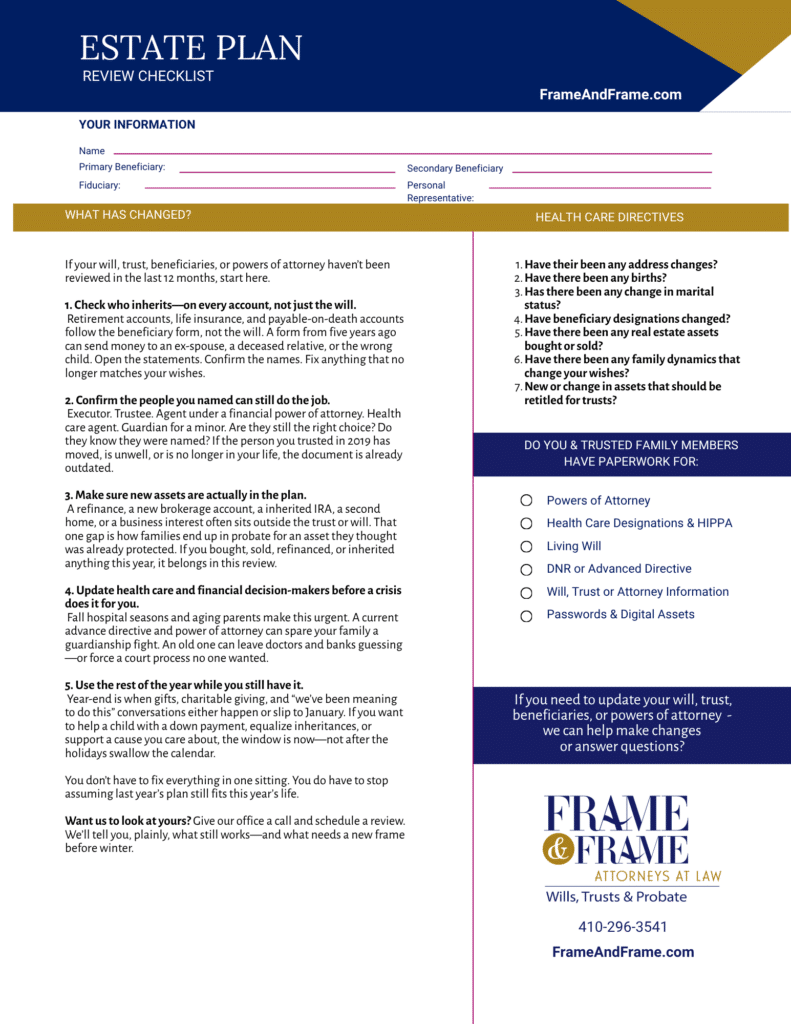
What to do next: Print the Estate Planning Checklist
Use the estate planning checklist to mark what has changed since your last review. Then get a second set of eyes on it.
Frame & Frame can review your current documents, identify what still works, and tell you plainly what needs a new frame before winter. We focus on estate planning, trusts, probate, elder law, guardianship, and special needs planning for Maryland families—with a practical, personal approach meant to take the weight off your shoulders.
Schedule a fall estate plan review. Bring what you have. We’ll help you leave with a clearer next step—and a plan that matches the life you are actually living.